Vitamin C is a star ingredient in skin care, and it is also one of the best-known vitamins in food. You may wonder whether you should eat it, apply it, or take a pill for better skin.
Here is how food, serums and supplements compare when it comes to vitamin C for skin.
Each option works differently, and the evidence varies. Here is how food, serums, and supplements compare, so you can decide what makes sense for you and your budget.
Why Your Skin Needs Vitamin C
Your body uses vitamin C to make collagen, which gives skin its structure. Harvard’s Nutrition Source lists vitamin C among the nutrients needed for collagen production.
It is also an antioxidant, which means it helps protect cells from damage by free radicals. Cleveland Clinic says these can come from sun, pollution, smoke, and other sources.
Option 1: Vitamin C From Food
Food is the simplest and cheapest place to start. Good sources include citrus fruits, red and green peppers, kiwifruit, broccoli, and strawberries.
The Linus Pauling Institute notes that two observational studies linked higher dietary vitamin C intake with better skin appearance and fewer wrinkles. Observational studies cannot prove cause, since people who eat more produce may also have other healthy habits.
Food also gives you fiber, other vitamins, and plant compounds that a pill does not.
Option 2: Vitamin C Serum
Serums put vitamin C directly on your skin. The Linus Pauling Institute says topical vitamin C has the most direct evidence for sun-damaged skin. Used for at least 12 weeks, 3% to 10% preparations decreased wrinkling and roughness and increased collagen production. Studies were small, and results varied from person to person.
Cleveland Clinic lists these possible benefits:
- Helps protect skin from free radicals
- May support collagen production
- Works alongside sunscreen for added protection
- May fade sun spots and other dark spots
Fading effects are temporary and can go away after you stop using the product.
Option 3: Vitamin C Supplements
Pills raise vitamin C in your skin, but the Linus Pauling Institute says levels stop rising once your blood is saturated. If you already eat well, extra vitamin C may not add much.
On sun protection, oral vitamin C alone did not offer a significant benefit in two human studies. Results were better when it was paired with vitamin E, but this does not replace sunscreen.
In healthy people, supplements did not shorten wound healing time. They do help people who are truly deficient.
Which Option Is Best?
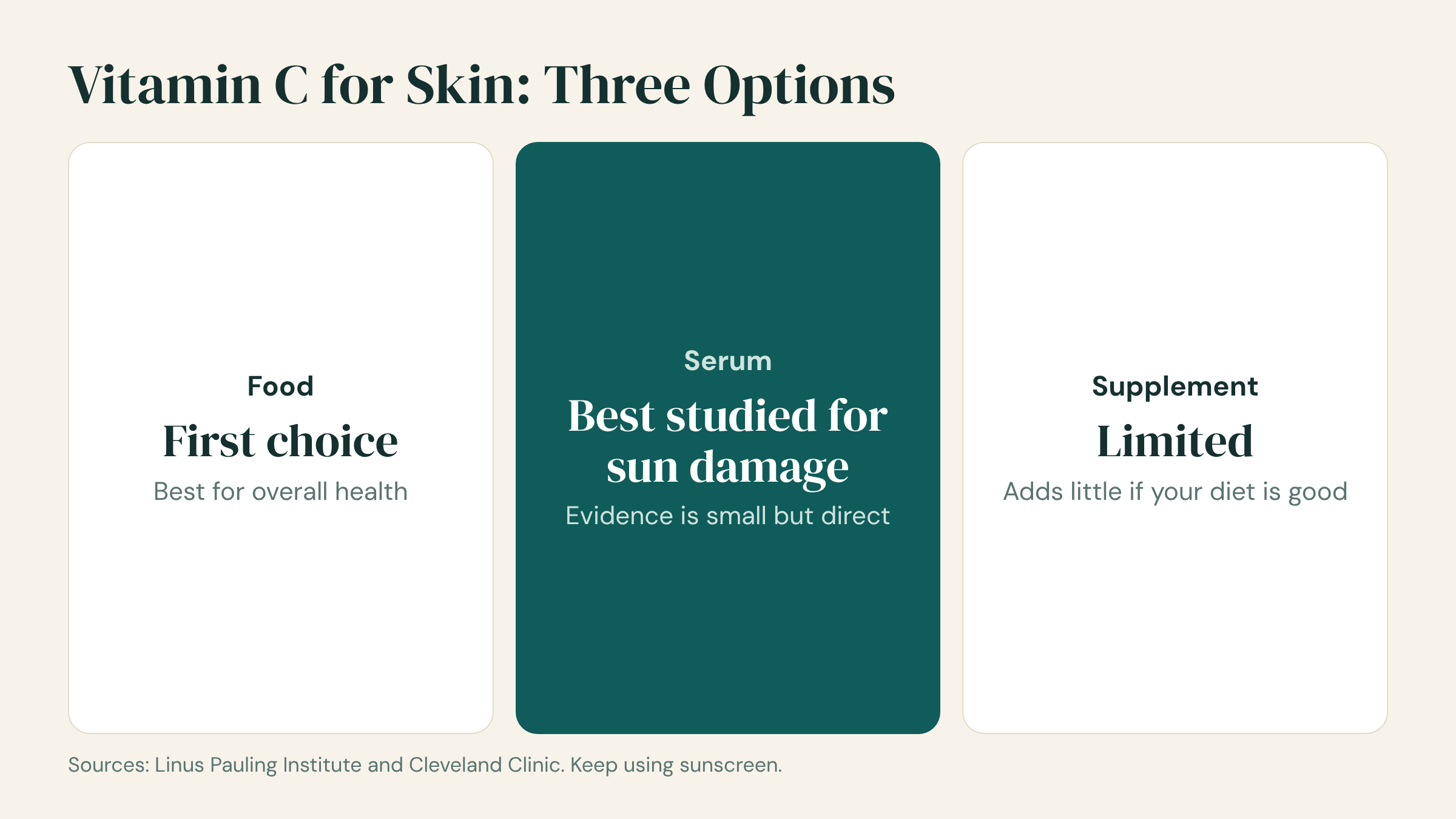
- For overall health: Food is the best starting point.
- For sun-damaged skin: A serum has the most direct evidence, although it is limited.
- For a known deficiency: A supplement may help, with medical guidance.
How to Choose a Vitamin C Serum
Cleveland Clinic offers these tips:
- Check the label: Look for “ascorbic acid” or “L-ascorbic acid.”
- Pick a sensible strength: Choose a concentration between 10% and 20%.
- Avoid very high strengths: Above 20% can seriously irritate skin.
- Look at the bottle: Vitamin C is sensitive to sun, heat, and light, so choose dark or tinted glass.
If you have sensitive skin, start with a low concentration. Stability is a known challenge, since ascorbic acid breaks down easily. If a product changes color, it may no longer be fresh.
How to Use a Vitamin C Serum
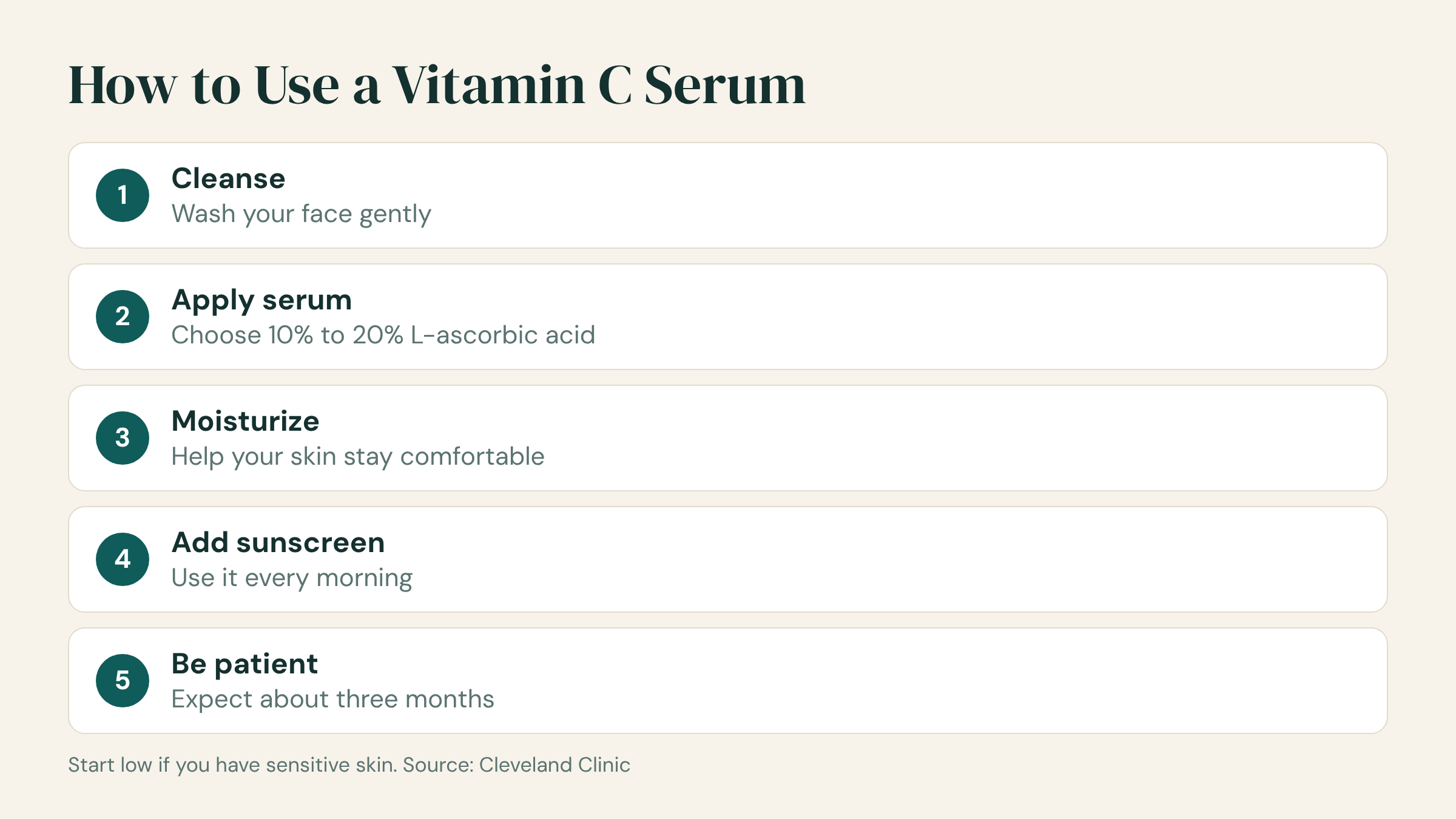
- Cleanse your face, and use toner if you normally do.
- Apply the serum.
- Follow with moisturizer.
- Finish with sunscreen in the morning.
You can use it daily. Cleveland Clinic says it is safe overnight, but morning use pairs well with sunscreen. Try a small patch of skin first if you are prone to reactions.
How Long Does It Take?
Expect about three months before seeing real effects. Taking a monthly photo without makeup can help you track changes more honestly than memory.
Side Effects
Cleveland Clinic says most people have no side effects. Rarely, dryness, itching, or redness can occur. Stop using it if your skin becomes irritated, and ask a dermatologist for advice if the reaction does not settle.
Do Not Skip Sunscreen
A serum does not replace sunscreen. The American Academy of Dermatology recommends a broad-spectrum, water-resistant sunscreen with SPF 30 or higher when you go outdoors.
Sun protection remains one of the most useful things you can do for your skin. Vitamin C works as an extra layer of help, not as a substitute.
Common Questions
Can I use vitamin C with other skin care products?
Often yes, but adding too many active products at once can irritate your skin. Introduce one new product at a time, and stop if you notice redness or stinging.
Does vitamin C help acne?
Evidence is limited. The Linus Pauling Institute says acne studies mainly used a derivative that may be poorly absorbed. If acne is your main concern, a dermatologist can suggest proven treatments.
Is more vitamin C better?
Not really. Very strong serums may irritate your skin, and your body limits how much oral vitamin C it stores. Follow the label on any product you use.
Can vitamin C help dry skin?
The evidence is unclear. A gentle moisturizer is usually a better first choice for dryness.
How to Store Your Serum
Because vitamin C is sensitive to light and heat, keep your bottle closed tightly and away from sunny windows. A cool cabinet is a better home than a steamy shower shelf.
Buying a smaller bottle can also help, since you will finish it before it has much time to break down. Check the label for the date by which it should be used.
Is It Worth the Money?
Serums can be expensive, and a high price does not always mean a better product. Compare the ingredient, strength, and packaging rather than the brand name.
If your budget is limited, put sunscreen first. It has stronger support, and it protects your skin every day. A serum is a nice extra when you can afford it.
The Bottom Line: Vitamin C for Skin
Eat vitamin C-rich foods for your whole body, and consider a serum if you want to target sun-damaged skin. Supplements add little if your diet is already good.
Whichever you choose, keep using sunscreen, be patient for about three months, and treat bold claims with caution.
Related articles
- Dry Skin After 50: Causes and Simple Care Tips
- How Sleep and Stress Affect Your Skin
- What Your Nails Can Say About Your Health
This article is for general information only and is not medical advice. Talk to a healthcare professional about your symptoms, and before starting any supplement, especially if you take medication or have a medical condition.